Growth strategy
Are Your Website Inquiries Turning Into Customers? A Lead Quality Guide for Small Businesses
Use a simple scorecard to see which website inquiries qualify, progress and become customers, then compare lead sources fairly.
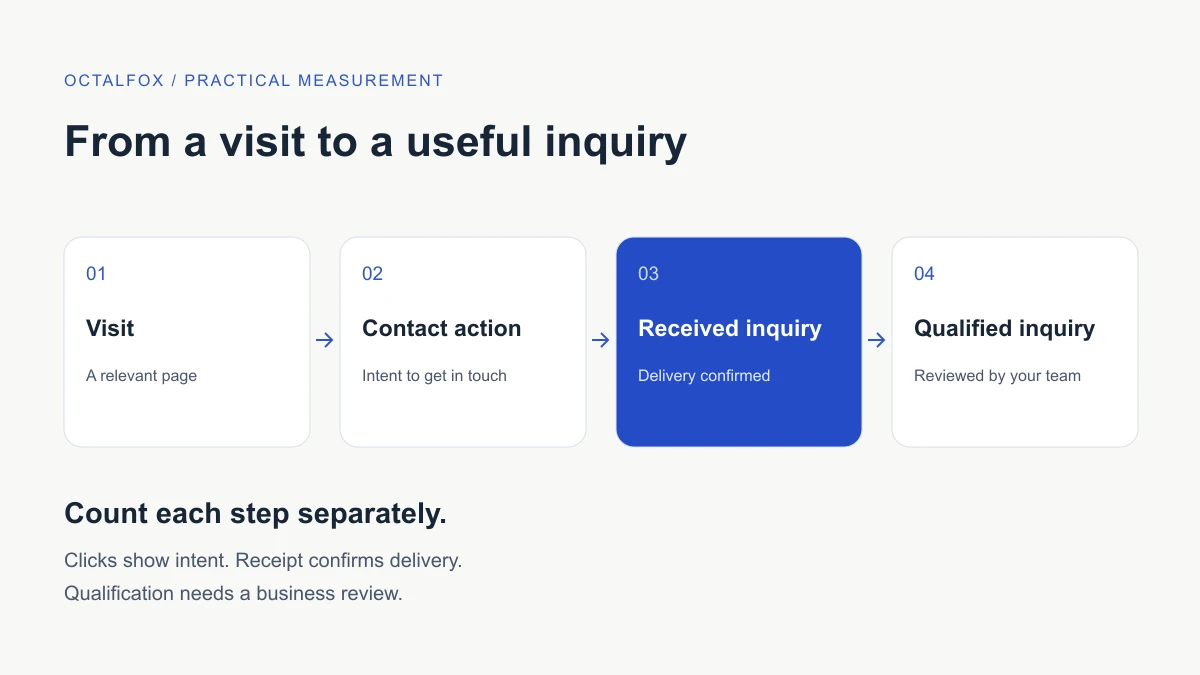
A useful inquiry report tells you how many people became customers and where the others stopped. Start by tracking every genuine website inquiry through the same stages, including phone calls and booking requests when you can reliably connect them to the website.
Agree on what makes an inquiry qualified
Write down two or three criteria your team can apply consistently. A commercial cleaning company might use service area, property type and whether it can provide the requested service. A project budget can be a criterion if there is a clear minimum and the team has enough information to apply it fairly.
Keep pending as a separate status for inquiries you have not assessed. Someone you could not reach may still be a good fit. Record why an inquiry was ruled out so you can distinguish a targeting problem from a capacity problem or a service you do not offer.
Track one inquiry through to an outcome
Use a shared system with one record per opportunity. Link repeat messages about the same request to that record. Start with these fields:
- Received: date, channel and source if known. Keep unknown sources visible.
- Qualified: yes, no or pending, with a short reason where useful.
- Conversation: date a substantive exchange took place.
- Proposal or booking: date the next step was agreed or sent.
- Outcome: won, lost or open, with a close date and a reason when you have one.
Keep access to individual records limited to the people who handle the work. Share aggregate counts in the scorecard. For help reconciling form submissions and messages, start with how to measure website inquiries.
Compare sources using the same group of inquiries
Group inquiries by the month they arrived. Give each group enough time to progress before comparing sales. The example below uses invented numbers and assumes the same observation window for both sources.
| Source | Received | Qualified | Conversation | Proposal or booking | Won |
|---|---|---|---|---|---|
| Paid campaign | 40 | 10 | 8 | 5 | 2 |
| Organic search | 20 | 12 | 10 | 8 | 4 |
The paid campaign generated twice as many inquiries. Organic search produced four customers from 20 inquiries, a 20% inquiry-to-customer rate, compared with two from 40, or 5%. Before moving budget, check acquisition cost, customer value, sample size and the number of open opportunities. Look at the qualification counts to decide where to investigate first.
Use the scorecard to choose one change
If many inquiries fall outside your service area, check the targeting and make coverage clear on the landing page. If suitable inquiries rarely reach a conversation, review ownership and response times using the website inquiry follow-up process. If proposals stall, review the reasons prospects give and test a clearer next step.
Record the change, the stage you expect it to affect and when you will review it. The lead diagnosis worksheet helps you choose which stage to tackle.