
Marketing
How to Turn Search Console Queries into a Website Content Plan
Use Search Console queries to choose useful content updates. Group customer questions, check existing pages and write a focused brief before adding another blog.
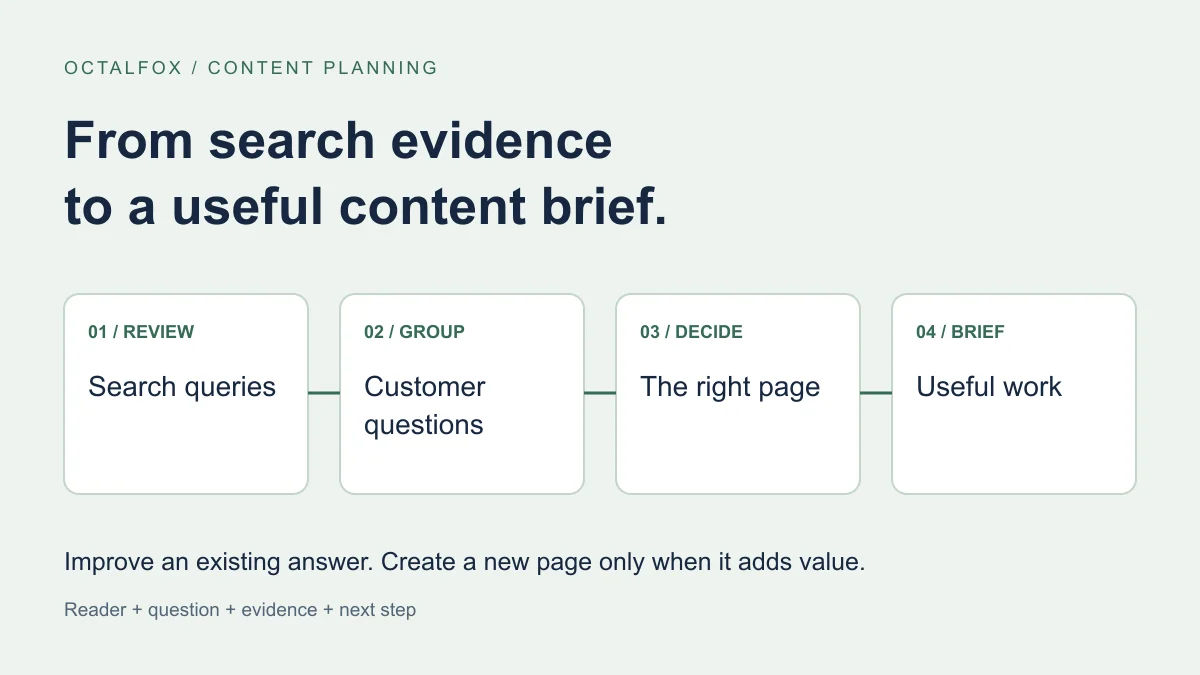
Search Console queries can help you decide what to improve on your website, but a query list is not a publishing calendar. First identify useful customer questions, check which pages already answer them, and choose whether to update an existing page or create a distinct supporting article.
The aim is a small, evidence-based content plan. Each proposed task should name the reader, the question, the page responsible for answering it and the next step it supports. Here is a practical way to build that plan without writing a new blog for every search phrase.
Start with a consistent report
Open the Search results Performance report in a property you control. Record the date range, search type and market filters so you can reproduce the view. Compare equivalent periods and allow for incomplete recent reporting. For a low-traffic website, use a longer window rather than treating a few daily impressions as a trend.
Keep the overall result alongside the query detail. Google’s Performance report guide defines clicks, impressions, CTR and average position, and explains that chart and table totals can differ because of how data is grouped. Do not force unlike totals to match.
Separate branded searches from searches that express a service need or question. Apply country filters that match the business decision you are making. A useful query from one market does not automatically justify country-specific versions of the same article.
Group searches by the question behind them
Read each relevant phrase as a clue about a task. Someone searching for a website handover checklist may need to verify what they will receive from a developer. Another person searching for ongoing website support is considering responsibilities after launch. Those questions are related, but they are not interchangeable.
Put close variations together. “Who owns my website?” and “website ownership rights” may belong in one ownership group. Do not create separate articles simply because the wording differs.
Keep unrelated searches in a separate review list. If a result appears for a business you do not serve or a service you do not offer, it is not automatically a content opportunity. Record it without letting it dictate the editorial plan.
Check the page that currently receives the query
For each promising group, inspect the associated page in the report and read it. Does the page answer the question clearly? Does it attract the audience you intend to serve? Is a useful answer hidden beneath unrelated material?
Choose one of four actions:
| Action | When it makes sense | Example task |
|---|---|---|
| Keep and monitor | The page already answers the question and the evidence is limited | Record the baseline and review later |
| Improve the existing page | The same reader and purpose are already served, but an answer is incomplete | Add a clear handover responsibility checklist |
| Create a supporting article | A narrower question needs a substantial answer of its own | Explain how to review a website support proposal |
| Investigate first | The query, audience or page relationship is unclear | Check whether the phrase reflects a relevant customer need |
These examples are illustrative, not claims about a client’s performance. If a commercial service page already owns the hiring intent, keep that role. A supporting blog should help the reader evaluate a particular decision, then link to the relevant service when useful.
Use the numbers to ask better questions
Impressions show that your site appeared in results; they do not establish the total market demand for a topic. CTR is clicks divided by impressions. Average position summarises results across the selected observations, rather than promising that every searcher saw the same rank.
For example, an illustrative page with one click from ten impressions has a 10% CTR. One more click would make that 20%. That large percentage change comes from one additional visit, so the counts matter more than the headline increase.
Do not rewrite a title just because CTR looks low. Consider the queries, result positions, audience and page purpose together. First ask whether the title describes the page accurately and whether the content answers the relevant question.
If a page is missing from results altogether, check its indexing separately before treating the issue as a writing problem. The digital presence audit checklist explains how access, information consistency and customer routes fit into that wider review. For deeper search work, consider an agreed SEO scope.
Prioritise a few useful tasks
Choose work that has a clear audience, supports a real service or business need, and can add something useful. A query group with modest impressions may still reveal an important buying question. A much larger irrelevant group may offer little value to the business.
For each candidate, ask:
- Does this question come from someone we can genuinely help?
- Is there an existing page that should answer it?
- What original explanation, example or worksheet can we contribute?
- Does the proposed article have a clear purpose beyond repeating a service page?
- What should the reader be able to do after reading it?
Search data should inform these decisions alongside sales conversations, support questions and gaps in current content. If your site has little query data, record that limitation and use verified customer questions as another input. Do not invent a demand estimate.
Write the brief before drafting
Give the writer enough direction to produce a useful answer without prescribing repeated keywords in every heading. A short brief can include:
- Reader: The person, business context and stage of decision.
- Main question: The specific task the article will help them complete.
- Evidence: Relevant query groups, report dates and known limitations.
- Existing coverage: The pages reviewed and why this work adds something distinct.
- Proposed action: Improve a named page or create one stable article URL.
- Useful material: A decision table, worked example, checklist or verified project detail.
- Supporting destination: The relevant service or strategy page and a natural next step.
- Review: Who verifies facts, attribution, links and readiness before release.
For example, a support-proposal article could help a business owner compare responsibilities, response arrangements and exclusions. Its purpose would differ from the existing website maintenance overview, which introduces what ongoing upkeep involves. Make that difference explicit before commissioning both pieces.
Google’s people-first content guidance emphasises usefulness and original value. A list of query variations is a research input; it does not replace an answer that helps someone make a decision.
Review the supporting service page too
When a new guide is ready, check whether it would help someone on its related service page. Add a short contextual link where appropriate. Do not copy the whole article into the service page or turn every service page into a directory of all your blogs.
Keep commercial information current. If the research exposes an unclear deliverable, improve the relevant explanation after confirming the scope. If the service page already answers the hiring question well, preserve it and add only the useful resource link.
OctalFox’s content marketing approach connects research, page purpose, writing and review. The content plan should make that connection visible: the reader’s question leads to an answer, and the answer leads to an appropriate next step.
Measure the page against its intended job
Record what changed and when. Compare equivalent markets and reporting periods after enough data has accumulated to make the comparison useful. Look for relevant queries and visits, then review whether readers reach the intended service or inquiry route.
Do not treat a lack of visible query rows as proof that nobody searched, or a rise in impressions as proof of qualified inquiries. Report missing detail and keep search measures separate from business outcomes. If you cannot reliably measure successful inquiries, make that limitation clear.
Keep improving a useful page when the evidence points to a specific gap. Create another article only when a different question deserves its own answer. If you need help turning search evidence into a focused plan, share your website, priority services and customer questions so the discussion starts with the work that matters to your business.