
Growth strategy
How to Identify Your Ideal Customer Before Spending More on Marketing
Compare customer segments by buying behaviour, profitability and reach. Use a copyable ideal customer profile worksheet before increasing marketing spend.
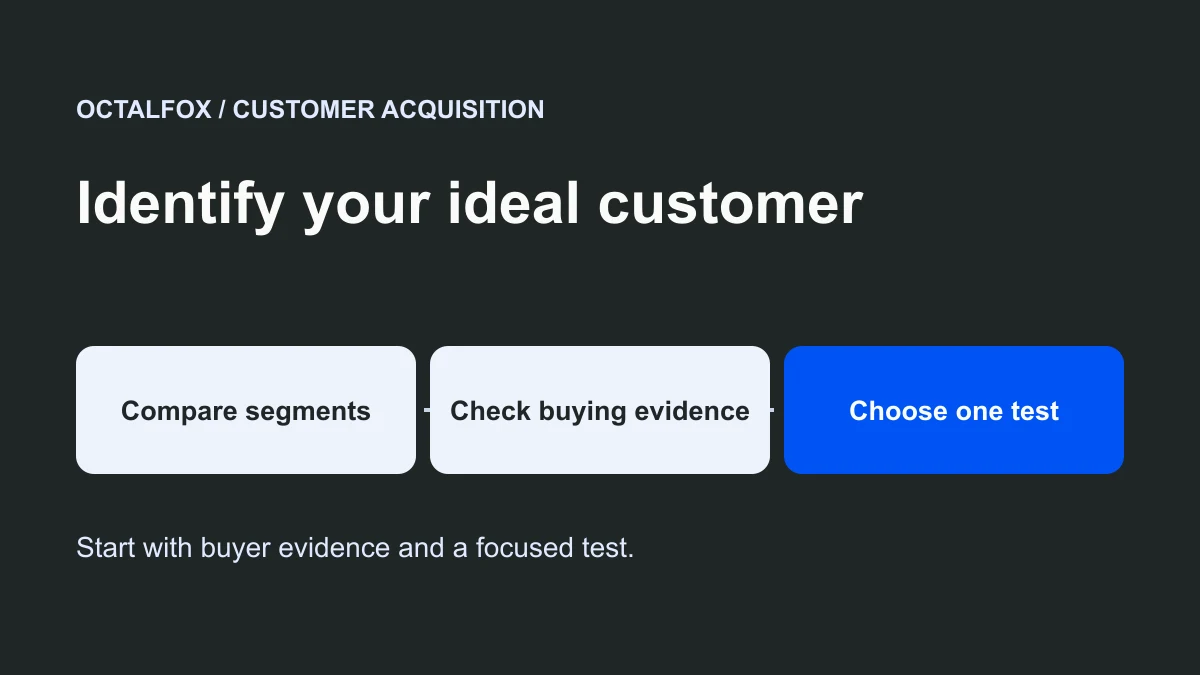
Identify your ideal customer by comparing groups of buyers who share a need and a reason to act. Start with evidence of who buys, what they pay, how much it costs to serve them and whether you can reach more people like them. Use that evidence to decide which group deserves your next marketing test.
An audience can include everyone who might see your message. An ideal customer profile describes the group you would deliberately seek for a specific offer. For a business selling to other companies, record both the type of company and the person who owns the purchase decision. For a consumer offer, describe the buying situation, such as a household moving within 30 days.
Compare two or three customer segments
Choose one offer and review comparable customers from a recent period. Include people who bought, prospects who declined and opportunities that never progressed. Group them by a shared problem, purchase trigger or delivery need. A group described as “clinics replacing a booking system after repeated missed inquiries” gives you more to test than “healthcare.”
For each group, record qualified opportunities, wins, typical revenue, direct costs and the time required to close and deliver. Estimate contribution per customer by subtracting direct delivery costs, refunds and customer-specific support costs from revenue. Decide which costs belong in the calculation and apply that definition consistently. Then check whether you have a realistic way to find and reach similar buyers.
If you have few or no customers, use recent buyer interviews, competitor offers and small paid trials where feasible. Mark estimates as provisional and keep the original counts alongside any rates. The U.S. Small Business Administration’s market research guidance covers how to investigate demand, pricing, alternatives and buyer behaviour.
Check what prompted people to buy
Interview recent buyers and a few people who chose another option. Ask about a specific purchase so they can describe what actually happened.
- What happened that made you start looking?
- How were you solving the problem before?
- What alternatives did you consider, and why did you rule them out?
- Who approved the purchase and what gave them confidence?
- What delayed the decision or would have made you walk away?
Compare what people say with what they did. A buyer who cites price may have paid more for a faster start. Look for repeated triggers, objections and sources of trust. If buyers tell different stories, check whether you have combined two groups with different needs.
Work through a segment choice
Imagine a bookkeeping business that serves both hospitality operators and professional services firms. Over a comparable period it wins six of 12 qualified hospitality opportunities and four of 10 professional services opportunities. Average first-month contribution before acquisition costs is $180 for hospitality and $460 for professional services, using the same cost definition.
At those observed win rates, estimated first-month contribution per qualified opportunity is $90 for hospitality and $184 for professional services. Compare the cost of generating and qualifying each opportunity before deciding. If hospitality costs $25 per qualified opportunity and professional services costs $130, the estimated first-month contribution after those costs is $65 and $54 respectively. The ranking reverses. If a partner directory can bring the professional services cost down to $70, that segment would yield an estimated $114 per opportunity. These are test assumptions. Include attributable channel costs and staff time, and count each cost once.
The counts are small, so the team treats the result as a working hypothesis. It also checks whether hospitality customers stay longer or generate more referrals, which could change the decision. The numbers are illustrative.
The bookkeeping team decides to test the directory with a profile like this:
- Customer and trigger. Small professional services firms whose current bookkeeping delays monthly reporting.
- Decision-maker and disqualifier. The owner approves the purchase. Firms that need daily on-site bookkeeping fall outside the offer.
- Test and decision. Spend up to $700, including staff time, over 30 days. Continue only if the directory produces at least 10 qualified opportunities at $70 or less each and at least four become paying clients after the normal sales window. If prospects qualify but rarely buy, review their objections before expanding.
Fill in the ideal customer profile worksheet
Complete one copy per candidate segment and compare your answers before committing budget.
- Offer and segment. We sell ___ to ___ in ___.
- Trigger and need. They begin looking when ___ because they need ___.
- Buying decision. The buyer is ___, the approver is ___ and their current alternative is ___.
- Evidence. In ___, we saw ___ qualified opportunities, ___ wins and ___ repeat purchases or renewals among ___ eligible customers. Our evidence comes from ___.
- Economics and delivery. Typical revenue is ___, direct costs are ___, contribution is ___ and time to serve is ___. We can comfortably serve ___ more customers.
- Reach and fit. We can find this group through ___. A poor fit for this offer would be ___ because ___.
- Next test. We’ll test one offer with ___ through ___, spend no more than ___, and review ___ by ___. We’ll continue if ___ and reconsider if ___.
If cost is unclear, use this guide to calculating customer acquisition cost to define how you’ll measure the test.
Test the profile before expanding spend
Choose one segment, one offer and one route to reach it. Use a short test with a fixed budget or effort limit. Track qualified responses and evidence of buying intent. For a long sales cycle, agree when you will review qualified responses and when enough prospects will have had time to buy. Revisit the profile if the test repeatedly reaches the right people but they describe a different need or buying trigger.
If lead volume or quality remains unclear, use the guide to diagnosing low lead volume. If you’d like help turning your worksheet into an acquisition test, share it with OctalFox.